Leadership
I lead a team of 8 designers at BuzzFeed, working across BuzzFeed, HuffPost, Tasty, BF Island, and other apps. We also design the tools that power these platforms, including our CMS, curation system, and revenue tech.
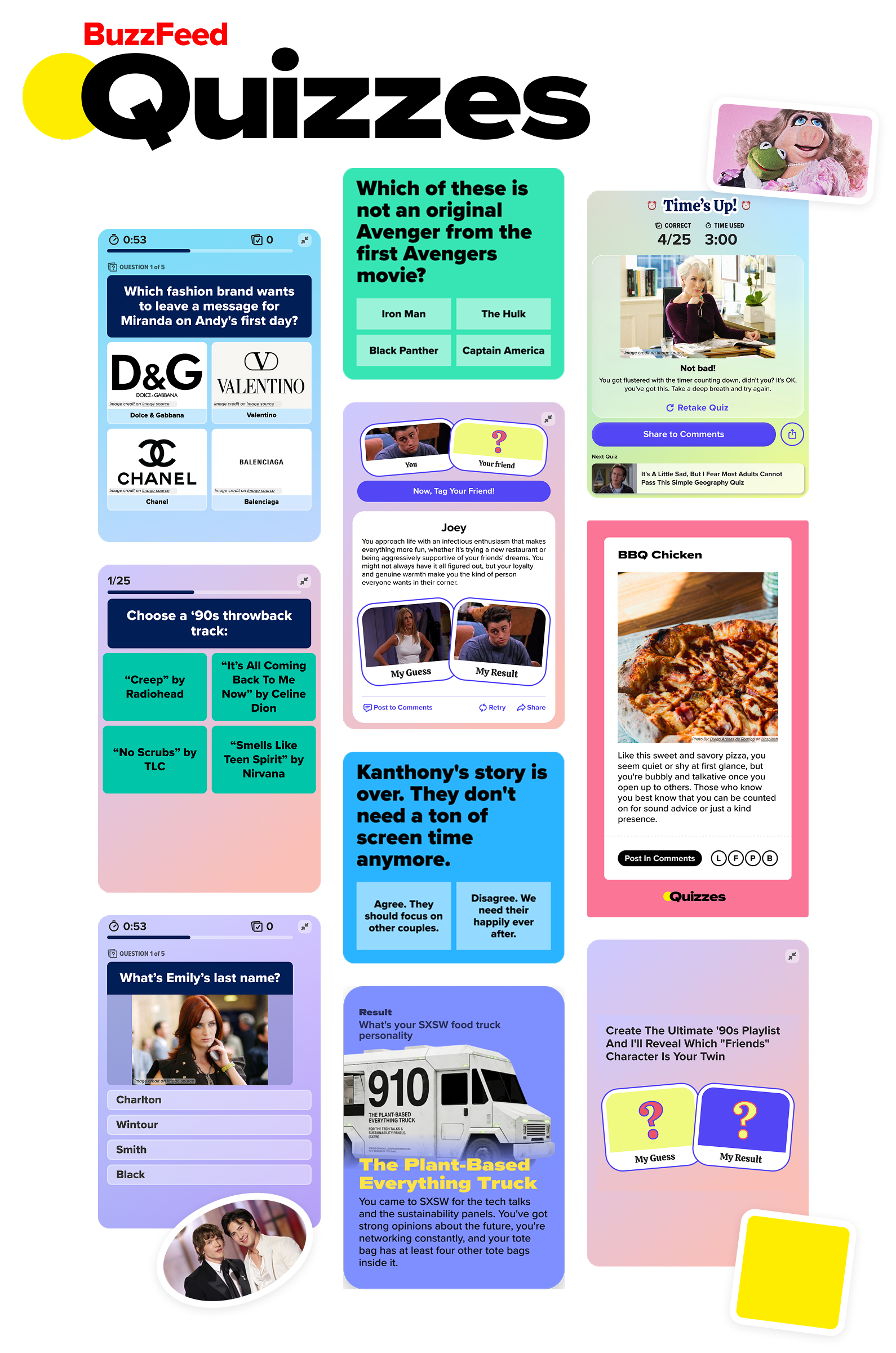
BuzzFeed Quizzes
Overview
BuzzFeed Quizzes are known all over the internet, spawning plenty of renown and copycats. They were also built for an earlier era of the web, back when most traffic came from laptops and shares were built around that format.
Our mission was to re-engage younger audiences by rebuilding the quiz lifecycle end to end, from how creators build a quiz to how people consume and share it on social platforms today.
My Influence
I led the design strategy to modernize BuzzFeed's quiz product and bring people back to the site.
Shifted to a Prototype-First Culture: I worked with leadership on how design, product, and engineering collaborated. Testing high-fidelity prototypes before official kickoffs cut planning delays by 50%.
Moved to Mobile-First Design: With 90% of our traffic on mobile, I moved the format from legacy scrolling to a card-based layout. That cut crash rates by 75%.
Launched New Formats: I led design for Timed Trivia Quizzes, which tripled retake rates. We track shares per quiz, retake rate, and RPM to measure what's actually working.
Unified the Brand: I ran a fast, cross-functional project with design, editorial, and social media to build one consistent visual identity for quizzes, replacing what had become a mix of inconsistent styles.
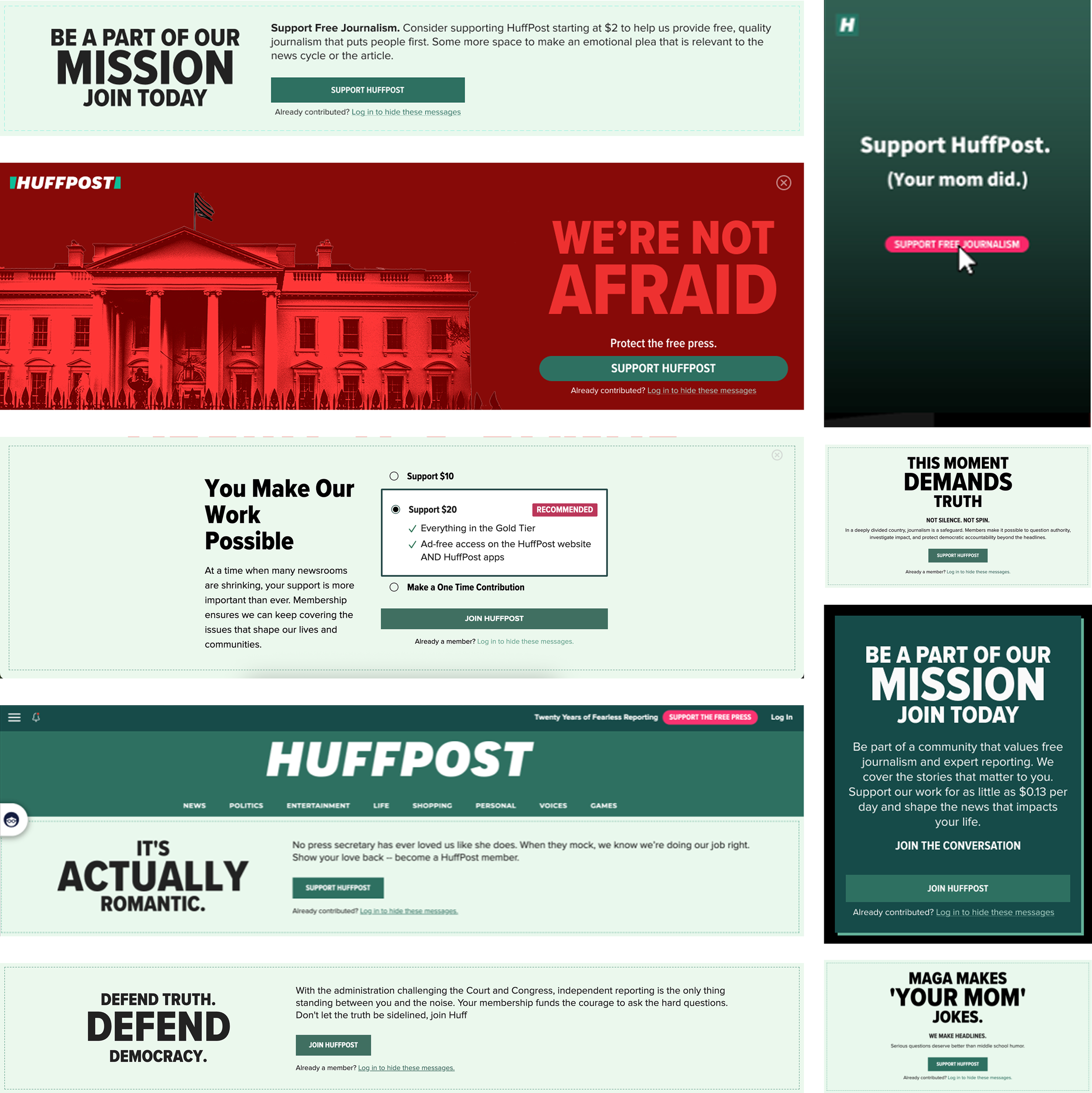
HuffPost Subscriptions
Overview
I led the design of HuffPost's tiered membership program in 2025, building on an existing voluntary contribution model, for an audience of 60 million monthly global readers.
Our mission was to design CTAs for memberships that read as part of the journalism rather than an interruption, while still driving sign-ups.
My Influence
Ran A/B Tests on Conversion Paths: I designed and tested two paths, one built around the ad-free experience, the other around our editorial voice, and set the visual rules for how these units appear across the site. Recurring revenue from the program grew from $1.2M in 2025 to $2.2M in 2026.
Built Campaign Tooling for Editorial: I directed design of the backend tooling that lets the newsroom launch and adjust campaigns in real time, so they can respond to breaking news as it happens rather than waiting on a design or dev cycle.
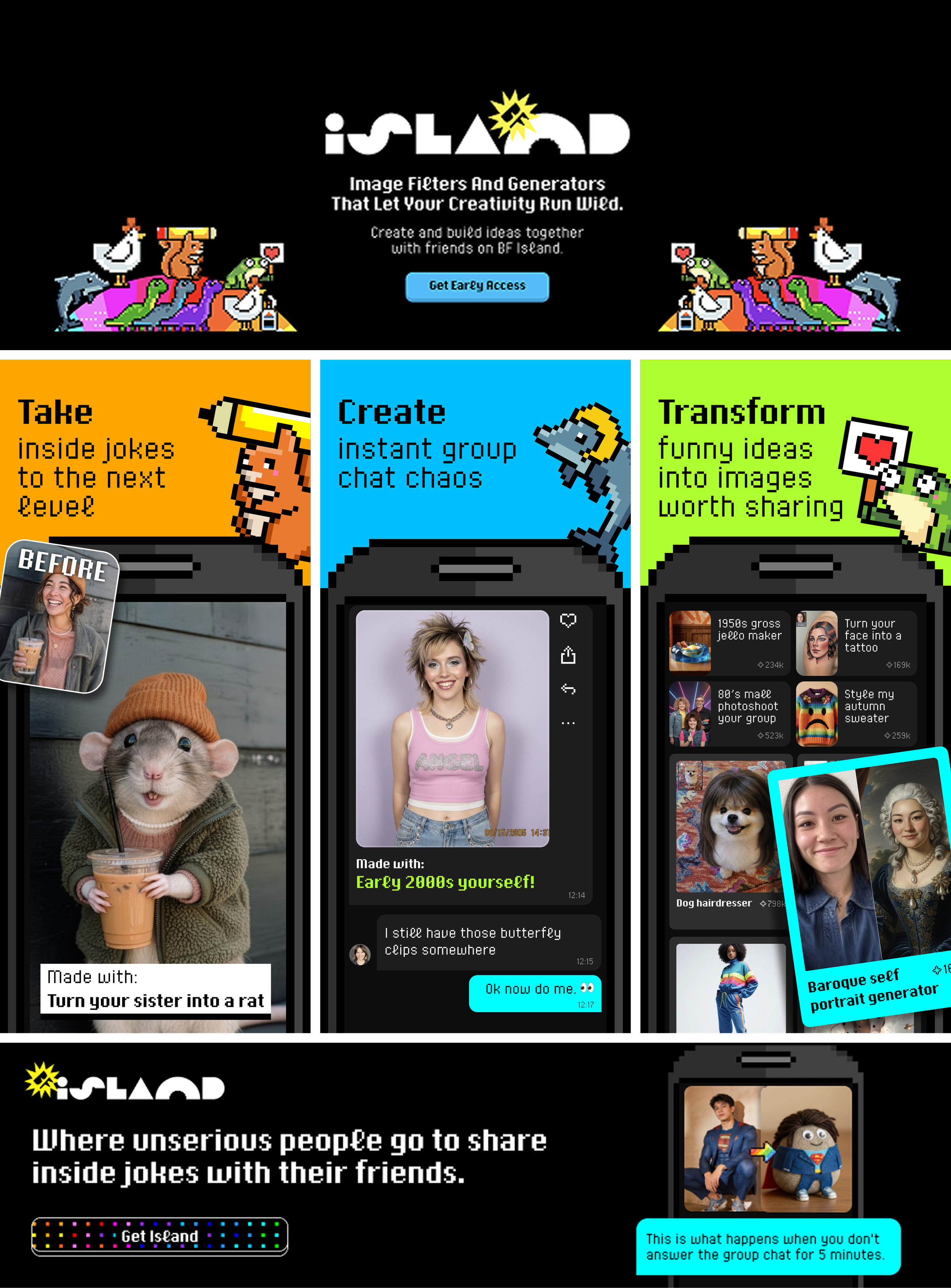
BF Island
Overview
Inspired by our CEO’s vision to use AI as a catalyst for human connection rather than just a utility, we set out to build a social app that used AI for connection between people, not just as a utility. The result was BF Island, a group chat app built around AI-generated prompts and content for group hangouts.
Our goal was to build, test, and launch it within a year, adjusting as AI technology moved.
My Influence
Turned Strategy into a Plan: I helped lead cross-functional workshops with leadership to turn the initial product vision into a concrete strategy, covering onboarding, feature set, and our path to product-market fit.
Led the Design Org for the Project: I was responsible for the design team's output on this project, balancing resourcing and hiring with hands-on work where it was needed, so the team could move fast.
Connected Brand and Product: I helped vet and manage our partnership with an external branding agency, translating their creative brief into our design system. The final identity was built specifically for our UI and AI use cases, not just as a standalone brand look.
Supported Go-to-Market Strategy: I worked closely with Product on marketing and launch positioning, and continue to as we grow the app's audience.
Product Design
A selection of my product design case studies, from enterprise SaaS tools to consumer growth work in digital media. Across all of them, my focus is the same: bridging complex internal systems with a simple, usable experience for the end user.
Timed Trivia Quizzes
I led design for Timed Trivia Quizzes, a fast-paced quiz format meant to give users a reason to come back. My goal was to turn that urgency into a stable experience rather than a buggy one.
Moving to a non-linear, card-based design solved two problems: it eliminated the scrolling bugs that were causing crashes, cutting crash rates by 75%, and it gave players a reason to immediately retake a quiz to beat their score. Timed Trivia now leads the portfolio in retake rate, and I'm leading the next phase, turning that engagement into revenue and better content recirculation.
BuzzFeed Curation
What started as a homepage refresh became a larger infrastructure project: a centralized tool for managing BuzzFeed's content across the site. I led design of a modular curation tool that lets our audience teams manage 100+ pages and feeds, both manually and programmatically, from a single interface.
My focus was building a system flexible enough for complex cases like multi-page feed syncing, sponsorship scheduling, and fast topic page creation, without needing a manual to use it. It's had zero support tickets since launch.
Workspace ONE Profiles
I led design strategy for Data Driven Profiles, a patent-awarded system that replaced platform-by-platform device configuration with a single deploy-once workflow. Based on the results of an early proof of concept, we overhauled the VMware EUC console, consolidating 17 separate endpoint management consoles into one system.
As end-to-end design lead for profiles, I coordinated across platform teams to integrate the new system into Freestyle Orchestrator, turning a set of manual, repetitive admin tasks into a single automated workflow.
VMware AirWatch Privacy
Low adoption was one of our biggest problems with AirWatch, driven largely by privacy concerns. As UX designer on this project, my goal was to close that trust gap: moving away from a surveillance-feeling product toward a transparency-first, educational interface.
I owned design and testing end to end, working directly with users to make sure the solution addressed their actual concerns. The result, Privacy First, was announced at VMware AirWatch Connect in September 2015 and launched in February 2016, ahead of GDPR formalization.